This time, we're diving into two of the most stunning astrophotography subjects: star trails and the Milky Way.
Star trails, the Milky Way, and composition.
This time, we're diving into two of the most stunning astrophotography subjects: star trails and the Milky Way.
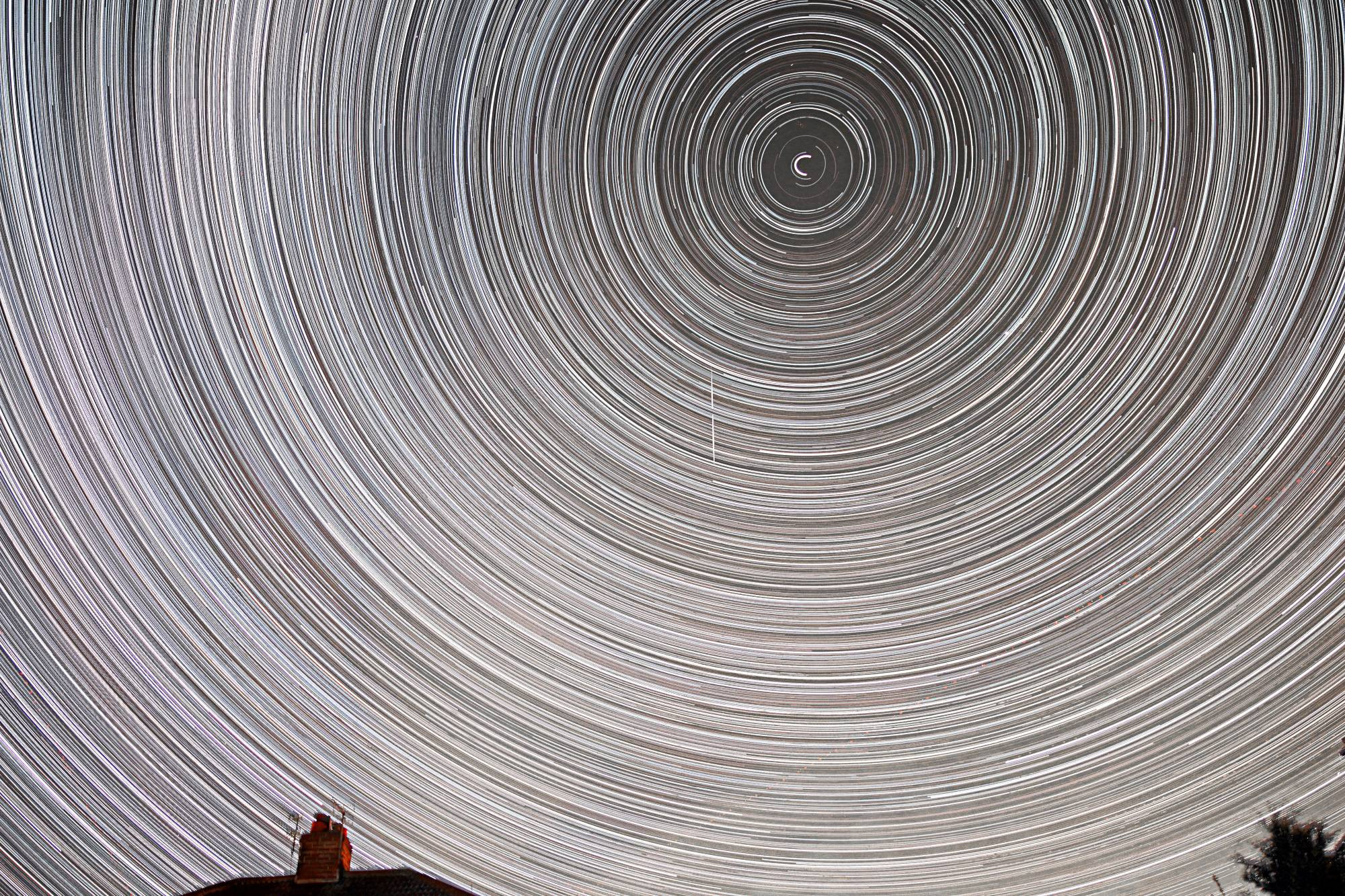 Let's start with star trails. To capture those beautiful circular patterns, set your camera to a low ISO, around 100-400, and a small aperture, like f/8. Use Bulb mode for the shutter speed and take an exposure for at least 30 minutes. Yes, I said minutes. If you have a programmable time machine, an app to control it, or a remote shutter release, now is the time to learn how to use those things. You simply can't hold the shutter button for 30 minutes. This image came from Steve Brown on BlueSky. If you're a member, you can link to it directly. He used many short exposures to avoid overexposing the sky, which is a more advanced technique.
Now, let's talk about the Milky Way. Sadly, one in three people on the planet live somewhere where the Milky Way is no longer visible due to light pollution. For my fellow travelers in the United States, it's even worse. 4 out of 5 Americans can no longer see the Milky Way from where they live. So if you have access to skies that aren't awash with city lights, this is the shot for you.
Use a wide-angle lens with a fast aperture, like f/2.8 or lower. Set your ISO to 1600-3200 and your shutter speed to 15-30 seconds. Make sure your focus is perfect and start shooting.
Remember, composition is key. Include some foreground elements to add depth to your shot. Another trick is to use a flashlight to paint some object in the foreground with light while you're taking the picture. This will take some experimentation, but you can get some very pleasing images that will really look amazing!
In the next chapter, we'll cover post-processing techniques to make your photos pop. Until then, clear skies, happy shooting, and I'll see you...in the dark!